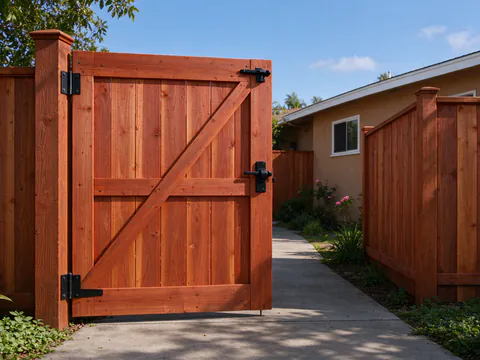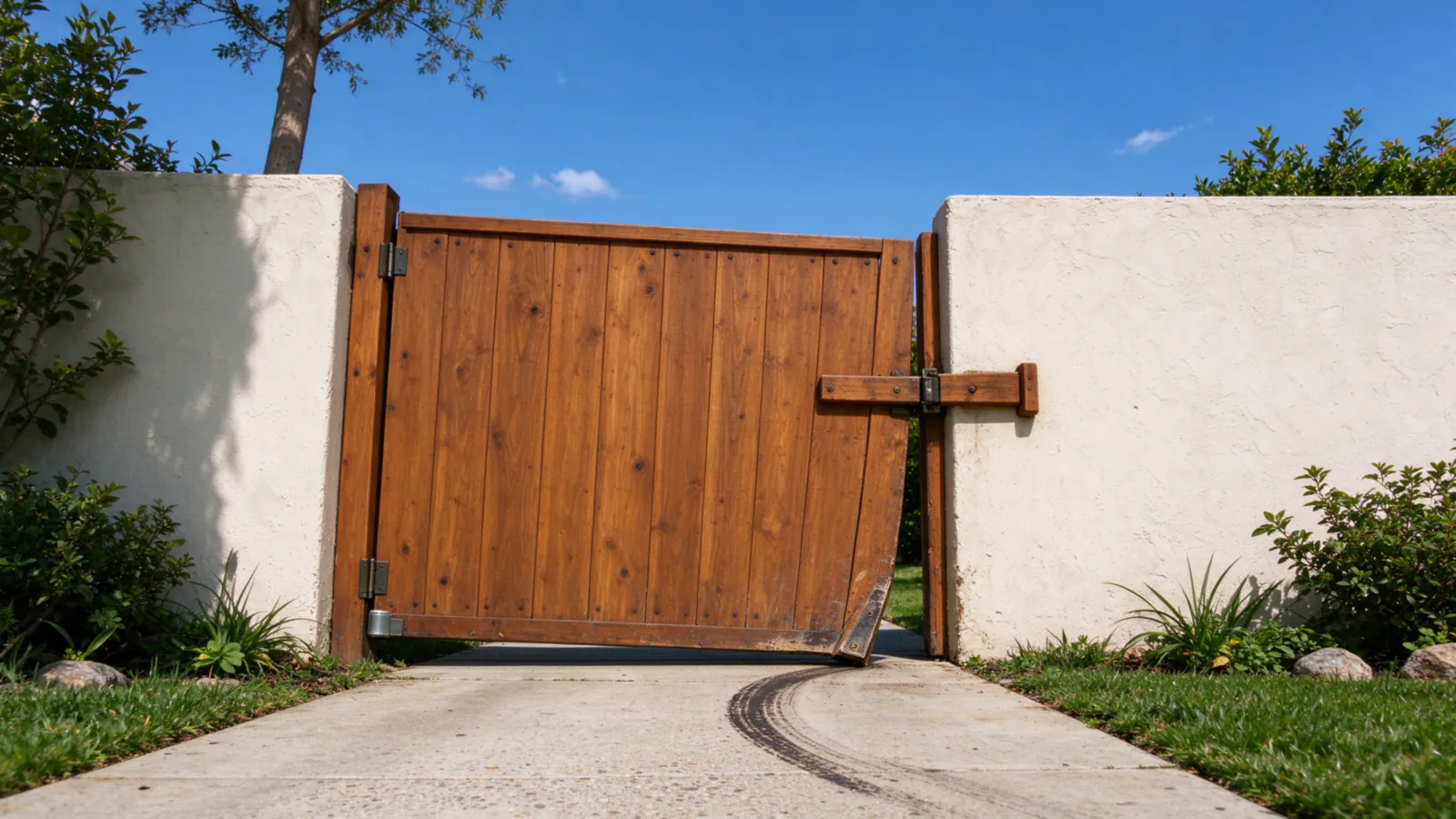
To fix a sagging gate, first find out whether the hinge post is leaning or the gate frame has racked. A leaning post needs to be reset or replaced in a larger footing. A racked frame needs a diagonal brace, a rebuilt frame or a cable kit. Tightening hinge screws alone rarely lasts.
Is your gate dragging or not latching? At Rancho Oxnard Fence we repair and build gates across Oxnard, and the fix depends on where the problem is. Here’s how to tell, and what each fix involves. For the service, see gate installation and repair.
Find the cause
Check the post
Stand back and look at the hinge post. If it leans toward the gate, the post or its footing has moved. Push the top of the post; if it rocks, the footing is loose. Check the base for rot or rust.
Check the frame
Close the gate and look at its shape. If the post is plumb but the gate is a parallelogram, with the latch corner lower than the hinge corner, the frame has racked.
Check the hardware
Loose or bent hinges and stripped screws make sag worse but are rarely the root cause. If the hinges are tight and the gate still drops, look again at the post and frame.
Why hinge posts lean here
A gate pulls sideways on its hinge post every time it opens and in every gust. Much of central and south Oxnard sits on loose, somewhat poorly drained sand with a high winter water table, which grips a post less than firm soil. A hinge post in a footing sized like an ordinary line post will lean in time. See fence posts in sandy soil.
Wind adds to it. Santa Ana gusts reach the Oxnard coastal plain, and a gate left unlatched in a gust swings hard against its hinges. See Santa Ana winds and fences.
The fixes
| Problem | Fix that lasts | Stopgap |
|---|---|---|
| Hinge post leaning, sound | Reset plumb in a larger, deeper footing | Brace the post temporarily |
| Hinge post rotted or rusted | New, heavier post in a new footing | None that lasts |
| Frame racked, no brace | Add a diagonal brace, or rebuild the frame | Anti-sag cable kit |
| Wide wood gate | Steel frame faced with wood | Cable kit |
| Hinges undersized or rusted | Heavier stainless or coated hinges | Tighten and shim |
Resetting or replacing the hinge post
The post is dug out, and either reset plumb in a larger footing or replaced with a heavier one. Digging needs DigAlert notice at least two working days before. In wet months, the hole is poured the same day it is dug.
Bracing the frame
A diagonal brace from the bottom hinge corner up to the top latch corner turns the gate’s weight into compression along the brace, which holds the frame square. A brace the other way does little.
Gate dragging or not latching?
Send a photo of the gate closed and the hinge post at ground level.
Re-hanging and latching
Once post and frame are right, the gate is re-hung with hinges sized to its weight, stainless or coated near the coast. The latch is set after the gate has hung for a while, so it still lines up when the post settles. See coastal fence materials.
When the gate itself is past saving
Some gates are not worth rebuilding. A wood gate with rotted bottom rails, split boards and a racked frame often costs nearly as much to repair as a new braced gate. Vinyl gates with cracked frames, and steel gates rusted through at the hinges, are similar. When the hinge post also needs replacing, a new gate and post together is usually the cleaner job.
Double gates
Double gates sag at the center when both leaves droop. Each leaf needs its own sound post and braced frame, a drop rod to lock one leaf, and a center stop. For vehicle gates, see swing vs sliding gates.
Preventing it on a new gate
- Hinge posts heavier than line posts, in the largest footings
- A braced frame from day one, or steel inside wide wood gates
- Hinges sized for weight and width
- A gate stop so wind cannot swing it past its limit
For wood gate care, see wood fence care, or call to have the gate looked at.